
WeDiscover Data Careers Framework: What Actually Makes A Great Data Professional
WeDiscover Data Careers Framework: What actually makes a great data professional

Share


Most career frameworks in data are built around technical skills: which tools someone knows, which methodologies they have been exposed to, whether they can write clean SQL, build a pipeline, deploy a model. These things matter. They are also, in my experience, usually not what separates good data professionals from great ones.
The people who progress furthest in data careers are almost never the most technically gifted. And the people who plateau are almost never held back by a technical gap. What actually makes the difference is something else, something the industry is not really talking about.
A harsh realisation
When you spend time reviewing CVs for a data role, you notice something fairly quickly. There are a lot of people out there with strong technical knowledge who are probably brilliant at what they do. And yet something is often missing: while their technical potential is unquestionable, the critical thinking that turns it into real business impact hasn’t caught up yet.
If everything someone can think of is a technical solution, that is a problem. Data work exists to help businesses make better decisions. That requires someone who can walk into a brief and ask whether it is the right brief. Someone who understands the commercial context before reaching for the data. Someone who takes end-to-end accountability for business impact rather than simply shipping deliverables. These things are very hard to find, and they do not show up on a CV.
Developing an eye for it in a hiring process is genuinely tough. It comes through in how someone talks about a problem, what questions they ask, whether they reach instinctively for the business context or jump straight to a technical answer. It is one of the harder skills in building a data team, and most hiring processes are not set up to test for it.
While technical data talent is abundant, strategic thinkers are remarkably rare.
Technical skills come with time
If somebody has decided they want to be a data professional, they usually already have a knack for the technical side. SQL improves with time. You start thinking about query costs, partitioning, data governance. Data scientists work through more model types and methodologies as their careers develop. These things come naturally enough if the foundation is there.
What does not come automatically is the behavioural side: business context, problem thinking, ownership of outcomes, communication that actually changes what a client does, and self-awareness about what is missing. These require deliberate effort in a way that picking up a new tool does not. And they are rarely talked about explicitly in data career frameworks, which tend to focus on the technical side because that is easier to define and easier to measure.
Most data professionals do not lack technical skills to progress. What is actually holding most people back is the behavioural component.
What we built at WeDiscover
This became a practical problem for us. We had an evaluation framework that listed specific technical skills, such as knowing Python, and being able to build a certain type of report. The usefulness of that technical criteria had an inverse correlation with seniority however: as the team grew and became more experienced, individuals required greater breadth in the skills they were assessed against. They required more colour on what they needed to develop, what progression looked like, and what they needed to do to take on more responsibility. A list of technical skills alone could not answer those questions.
We tried redefining things at a product level and hit walls. So we went back further. We mapped out our entire data ecosystem: every capability area, every domain, every tool and methodology that matters in performance marketing data work. That became the foundation for a proper technical skills map, covering nine knowledge domains, each with a proficiency scale from awareness through to authority, with different expectations by role rather than one generic standard applied to everyone.
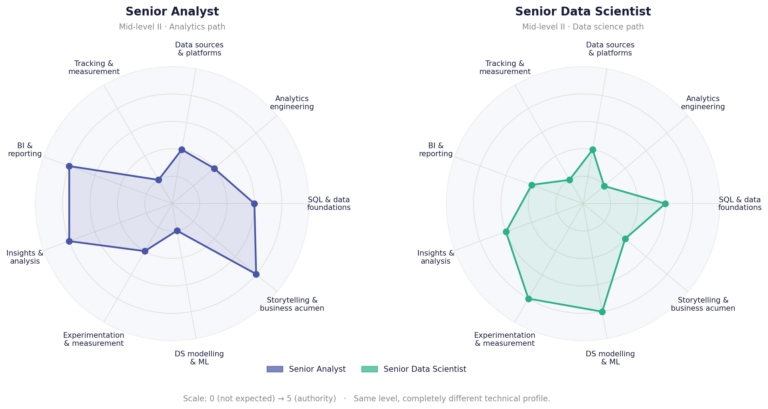
But as we worked through it, a pattern kept emerging. Technical proficiency alone was not telling the whole story. There were people who could do the work at a high level but were not quite ready for more responsibility, and the technical framework could not explain why. The gap was behavioural. How they thought about problems, how they communicated, whether they took real ownership of outcomes. That pushed us toward building a second part of the framework: a set of behavioural expectations that apply to every role, every level, every specialism. Six themes, defined at every level from intern to director, with specific observable behaviours rather than vague aspirations.
|
01
Ownership & Delivery How someone takes responsibility for work from receiving a task through to its outcome. |
02
Problem Thinking The ability to define the right problem, not just solve the one presented. |
03
Quality & Standards How someone treats the standard of their own output and at senior levels, the standard of the team’s. |
|
04
Communication & Influence How someone conveys their work and thinking, and how they land ideas with people who did not ask for them. |
05
Collaboration & Team Impact How someone operates as part of a team: giving and receiving feedback, sharing knowledge, building relationships. |
06
Leadership & Self-Development How someone grows themselves and develops others, starting with self-awareness and building toward developing teams. |
Self-assessment is built into the framework as a progression requirement at every level. The ability to accurately name your own gaps is itself a behavioural expectation. A review that lists achievements without naming real weaknesses is not a good review. This sounds obvious. In practice it is one of the rarest things you see.
To make this concrete, take Ownership and Delivery. On paper, everyone at every level is expected to deliver their work. In practice, what that means looks completely different depending on where someone is in their career.
Ownership & Delivery
Teams often struggle in the space between “I did the work” and “I owned the outcome.” That gap produces work that stalls, problems that surface too late, and a team that is technically busy but commercially passive. Ownership is what connects effort to impact.
How it changes across levels
|
Intern
Completes tasks when given clear direction. Raises blockers early and does not let things go quiet.
|
|
|
Junior
Delivers on defined tasks without supervision. Owns the quality of their output and fixes things before being asked.
|
|
|
Mid-level
Owns the problem, not just the task. Scopes the work, defines the approach, and holds accountability through to delivery without needing to be asked.
|
|
|
Senior
Owns outcomes across a client relationship or domain, not just individual pieces of work. Defines the approach for others to follow. Accountable when things go wrong, not just when they go right.
|
|
|
Lead
Owns delivery quality across a group, not just their own work. Sets priorities, says no to the wrong things, and holds the team accountable without micromanaging.
|
|
|
Manager
Brings in the right people and makes sure those they manage have the tools and conditions to do good work.
|
|
|
Head / Director
Full function ownership across headcount, commercial outcomes, and team architecture. Accountable for the function’s contribution to business strategy, not just operational delivery.
|
A conversation the industry needs
What we ended up with is one of the most comprehensive career frameworks I have come across in my career, in previous roles and in blog posts, newsletters, books and elsewhere. Most frameworks in data are either too generic to be useful or so specific to one company’s toolstack they mean nothing outside it. This one is grounded in the actual work of a performance marketing data team, and the behavioural side of it applies far more broadly than that.
We went out with the objective to have better conversations with the team, hire more deliberately, and actively develop people rather than just manage them. But the thinking behind it is something the industry should be talking about more openly. The behavioural side of a data career is where the real development happens. It is where the real gaps are. And it is where, in ten years of doing this, I have seen the most capable people hit a ceiling.